Thursday, October 9, 2014

Day 27: The Study Guide for Decimals

6th Grade Math Standards: 6.NS.3 Fluently add, subtract, multiply, and divide multi-digit decimals using the standard algorithm for each operation.

The Learning Objective: Add, subtract, multiply and divide multi-digit decimals.

Quote of the Day: Nails in the Fence:
"There once was a little boy who had a bad temper. His Father gave him a
bag of nails and told him that every time he lost his temper, he must hammer
a nail into the back of the fence.
The first day the boy had driven 37 nails into the fence. Over the next few
weeks, as he learned to control his anger, the number of nails hammered
daily gradually dwindled down. He discovered it was easier to hold his
temper than to drive those nails into the fence. Finally the day came when
the boy didn't lose his temper at all.
He told his father about it and the father suggested that the boy now pull out
one nail for each day that he was able to hold his temper. The days passed
and the young boy was finally able to tell his father that all the nails were
gone.
The father took his son by the hand and led him to the fence. He said, “Youhave done well, my son, but look at the holes in the fence. The fence will never be the same. When you say things in anger, they leave a scar just like this one. You can put a knife in a man and draw it out. But it won't matter how many times you say I'm sorry, the wound will still be there. A verbal wound is as bad as a physical one.”


Agenda:


  1. Jumpstart - Estimation 180 Days 28 and 29
  2. Review the homework with the class. What is a unit cost? Was the most popular question I heard from students. 
  3. Frayer Model with the 4 major operations in a word problem and out a word problem. Most students took a while before noticing that the same problem was on there twice. Students did this with their math partners
  4. Study guide done with the math partner
  5. If time allowed the students worked on the weekly quiz


The Assessment: I circumvented the room to see how students were progressing. In partners, I do find less errors of course with the whole two heads are better than one concept. Students struggled most with the concept of 9 - 0.7. One of my colleagues put together what we called a "vintage model" using decimal grids and taping it to a poster. I brought it into my last class and they loved it. Note to self next year I'm stealing that idea for my class too (per usual my colleague asked if she wanted to make one for me - it helps to work with people willing to share).

Homework: Students were asked to study for the decimal quiz tomorrow and do the weekly quiz which is also due tomorrow. In one class I told students that if they did not have their weekly quiz it would be a session. I wish I had done this in all classes but I didn't think to!

My Glass Half-Full Take: With one of my students that was struggling, I asked him to tell me the difference between when we slide decimals in division problems and when the decimal gets brought straight up in the quotient after I explained it to him ten seconds before. He nailed it. I too often explain to students in a one on one setting and then abandon them to go throw a life raft to a different group of students. I think the approach here was more effective because I could sense the effort that went into this student explaining it to me.

I'm also looking forward to the first day of Math Academy tomorrow. This is a club in our school that is run before school (a half hour before) that gives students who are passionate about math to work collaboratively on challenging problems. It includes all three grades in the middle school so I get to work with many former students. We're going to be investigating two visual pattern problems among others.

One Thing to Do Differently: Today we had a school fundraiser "The Rollathon." As a result a little over an hour of academic time was cut meaning that every class was a little shorter. This obviously caused confusion as anything out of the routine typically does. As a result of the shorter classes, if I was to do this lesson again I would want to add in a piece about reflection from the study guide (similar to my glass half-full story) where a student recounts a mistake they made and explains the correction. With more time on a typical day this would be possible. That said, The Rollathon was a great success. Money was raised for field trips, the kids had a great time, and I got to feed the math curriculum asking every lap the students ran how far they had run (7 laps divided by 4 laps for one mile is equal to 1.75 miles).

Link of the Day:

Wednesday, October 8, 2014

Day 26: Dividing Decimals with Decimal Divisors

6th Grade Math Standards: 6.NS.3 Fluently add, subtract, multiply, and divide multi-digit decimals using the standard algorithm for each operation.
MP3 Construct viable arguments and critique the reasoning of others.

The Learning Objective: Divide decimals to find a quotient.

Quote of the Day: “Accountable people look for solutions, not scapegoats. They blame no one. They ask questions like what could I have done differently? And how can I learn from this experience?” - John G. Miller

Agenda:
  1. Jumpstart using Estimation 180 Candy Corns (Days 25 through 27)
  2. Review the homework. I specifically liked the question will 2.7 divided by 3 be greater than or less than 3.
  3. This division of decimals notes "discovery" sheet which was the highlight of my month so far (more on that with the glass half-full).
  4. Notes on division of decimals with decimal divisors.
  5. Students started their homework on division of decimal with decimal divisors.
The Assessment: The first assessment was me checking their homework. I was looking to see that students were bringing the decimals up into the quotient and they were rather successful with this task. The second assessment came during the discovery sheet. Students made the connection that as a divisor got smaller, a quotient got larger. That said, it was interesting to note that they could not explain what happened when a number was divided by 0. The third assessment came as I let students try a division of decimal problems independently after providing a couple of examples. Finally, students had about twenty-five minutes to work on their homework in class. I'm really proud of the effort that students are putting into the homework during class time. The room was quiet without me having to say much which demonstrates students are learning a routine and learning respect. In going around the room during this time, it also verifies that students are able to accomplish what I'm asking in the objective, which gives me reason to sleep at night. And I'm generally a healthier and better person when I'm sleeping.

Homework: The students did thirteen problems about the algorithm, theory, and word problems with division of decimals. In addition to this the weekly quiz is due in two days and they have a decimal quiz in two days.

My Glass Half-Full Take: In two classes (I didn't see the third class for this activity unfortunately), nobody could tell me what 360 divided by 0 was. They all initially said 0. One student even explained by trying to turn the question around into a multiplication problem. They were excited to argue their point and it was the first genuinely good discussion we've had this year. Given the momentum and interest of the discussion I didn't tell one class what the answer was. The other class was so invested and unwilling to move on that I typed it into my iPhone calculator and it showed error on the screen. I didn't explain why though.

One Thing to Do Differently: In my first class, I passed out this Frayer Model with all four operations. It was not a bad activity, but left me with less time to accomplish solely today's objective which was to divide. I changed this in my next couple of classes and believe this activity would be a better use the next class when we did the study guide which encompassed every operation.

Link of the Day: Daydreaming is good. And in the day of the cell phone it is increasingly hard to do.

Tuesday, October 7, 2014

Day 25: Dividing Decimals with Whole Numbers

6th Grade Math Standards: 6.NS.3 Fluently add, subtract, multiply, and divide multi-digit decimals using the standard algorithm for each operation.

The Learning Objective: Multiply decimals to find a product. Divide decimals with whole number divisors to find a quotient.

Quote of the Day: “In a game against the San Francisco 49ers, Jim Marshall spotted the football on the ground. He scooped it up and ran for a touchdown as the crowed cheered. But he ran the wrong way. He scored for the wrong team on national television. It was the most devastating moment of his life. The shame was overpowering. But during halftime he thought, ‘If you make a mistake, you got to make it right. I realized I had a choice. I could sit in my misery or I could do something about it.’ Pulling himself together for the second half, he played some of his best football ever and contributed to his team’s victory.” - Carol Dweck

Agenda: The first part of class was a continuation of multiplying decimals. The second part of class was an introduction to dividing decimals. Today we only talked about divisors with whole numbers.


  1. Jumpstart with adding and subtracting decimals to combat the fact that students might forget to lineup decimals after we multiplied. 
  2. Review the homework from multiplying decimals the previous night. I loved the question that asked students if the product of 0.4 x 1.8 would be greater than 0.4 and to explain why. 
  3. The students worked in partners on the algorithm of multiplication. I went around the room to assist them and asked the question how many times does the decimal move in each problem until I felt confident students understood the process. 
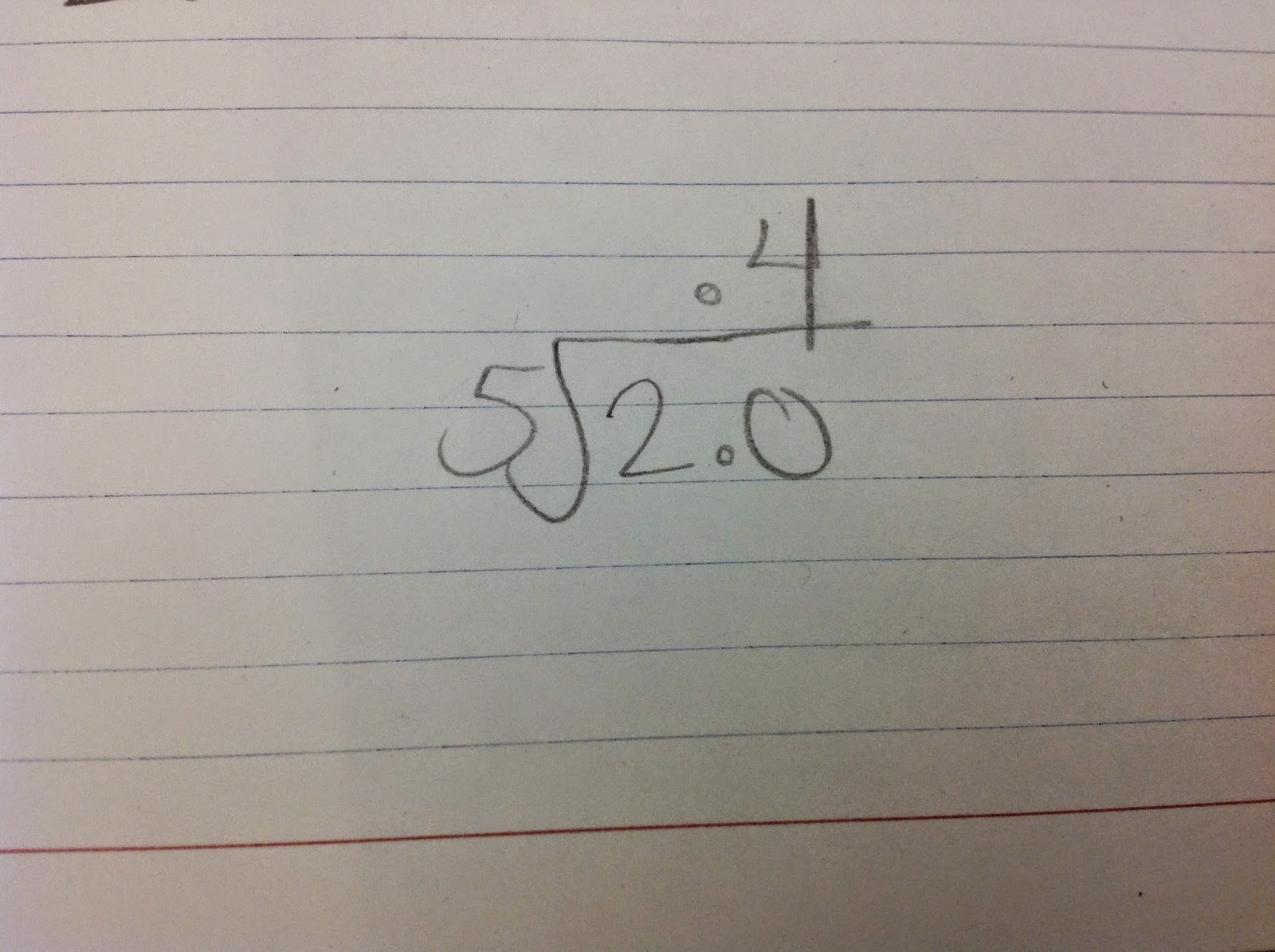
  4. I gave students a My Favorite No problem of $2.50 divided by 2. When too many students were successful, I changed the problem to say 2 divided by 5. This proved to be a question that less than half the students could successfully answer. Most of them did 5 divided by 2.
  5. We took notes on dividing decimals with whole number divisors after the students had a chance to try it on their own.
  6. I had the students do one problem independently from the notes to verify they were annexing zeros and bringing the decimal up correctly.
  7. The students started their homework with about 10 minutes left which was a division of decimals worksheet. 

The Assessment: In the first class my assessment was to go from student to student as they worked in partners on the review to see if they could tell me how many times to move the decimal. I also checked homework and the weekly quiz as always.

In the second class, I checked one problem that they did independently on the notes and also went around to verify students were comfortable with the first couple of problems on the homework. We also did the problem as part of My Favorite No before starting the decimals lesson. The problem was 2 divided by 5.


Homework: A division of decimals worksheet. I'm finding my homework assignments to be more effective this year than ever before with having an extra block to teach. In every class, students are starting the homework, getting feedback, and gaining confidence in knowing that they can do it. From there it's a matter of practicing and fluency. I'd like to give students less problems and more challenge in some cases however as I believe some of them may grow board from the lack of challenge and mindless repetition.

My Glass Half-Full Take: One of my students said, "After these messages I'll be right back." We ended our first class in that block at 11:12 and they came back after lunch at 12:30. I was glad to hear that someone born after the year 2000 knew the jingle to the cartoons I used to watch in the 1990s.

On the math side of things, I always enjoy seeing students think about a question such as 2 divided by 5. Some of the answers I received were that it can't be done (and I acknowledged this point by stating it would not make sense to divide 2 cars into 5 pieces).

One Thing to Do Differently: The multiplication review worksheet I'd like to use next time is right here. Some of the material is taken from Yummy Math and some of it is tweaked by me. Students still do fifteen multiplication problems with decimals and it asks students to add a bunch of numbers when they are done. It is also more motivating to see that at the end of the problem the number has some meaning rather than having a worksheet just pull numbers out of the sky.

I'd also like to show students this picture to demonstrate that it is ok to lineup the decimals in multiplication. I don't find it to be the easiest or cleanest way of doing things, but it leads to the correct solution.


Link of the Day: I really enjoy this article on the textbook and agree that I could certainly live without it. Currently we have a textbook and I've used it twice this week, but as the link above indicates math can come to life best through our own visions.

Monday, October 6, 2014

Day 24: Adding, Subtracting and Multiplying Decimals

6th Grade Math Standards: 6.NS.3 Fluently add, subtract, multiply, and divide multi-digit decimals using the standard algorithm for each operation.

The Learning Objective: Add, subtract, and multiply numbers with decimals.

Quote of the Day: “Discipline is doing what you really don’t want to do so that you can do what you really do want to do.” - John Maxwell

Agenda:

  1. Jumpstart - place value 
  2. Review the homework from the previous class
  3. Return previous week's weekly quiz and pass out this weeks for students that have not received it yet.
  4. Frayer Model type of sheet with four different word problems done in partners
  5. Color decimal grids for modeling multiplication with decimals
  6. Multiplication of Decimal Notes
  7. Let students begin the decimal multiplication homework


The Assessment: In the first class the word problems and the homework was used to assess students ability to add and subtract decimals. In the second class, I had students try problems from the notes independently and then had student checkers go around to verify answers and help students that had gaps.

Homework: For the second straight class we used the textbooks as part of the homework. This time the assignment came from page 205 #1-9, 13, and 17 out of the Glencoe book. It was important for them to skip certain problems since they included problems such as the distributive property which have not been learned yet. I did offer this particular problem as a challenge to the students who would need it.

My Glass Half-Full Take: The Frayer Model word problems went very well. It also was nice to get students moving out of their seats right in the middle of class. Walking around the room students demonstrated solid ability when dealing with numbers that showed only the ones place and annexing zeroes to include other place values. We also had a great conversation about how gas prices have a third decimal or even a fraction after the decimal.

One Thing to Do Differently: Tomorrow I have another opportunity to teach multiplication of decimals for 50 minutes or so. I believe this will be essential based on the difficulty students were initially confronted with after school today. I'm not sure how much coloring the decimal grids helped with my students, so I will confer with colleagues to see if this helped their lessons.

Link of the Day: I really like this lesson on the greatest NBA seasons presented by Yummy Math. I thought about incorporating it into my lesson tomorrow, but decided it was too quick of a turnaround at the end of the day to photocopy and tweak things to make it easier to do in twenty-five minutes. I'm definitely going to hold onto this as something to do in the future however.

Sunday, October 5, 2014

Day 23 Adding Decimals

6th Grade Math Standards: 6.NS.3 Fluently add, subtract, multiply, and divide multi-digit decimals using the standard algorithm for each operation.

The Learning Objective: Add and subtract decimal numbers.

Quote of the Day: “As much as our culture talks about individual effort and self-improvement, deep down we revere the naturals. We like to think of our champions and idols as superheroes who were born different from us. We don’t like to think of them as relatively ordinary people who made themselves extraordinary. Why not? To me that is so much more amazing.” - Malcolm Gladwell

Agenda:

  1. I collected Weekly Quiz #2 from all the students
  2. Students self-assess their quizzes as they are returned
  3. Review the quiz as a class 
  4. The class took notes on decimals
  5. We did a ticket to leave (or enter the second class with this problem). This problem was intentionally done wrong by me and students had to state whether it was correct or if there was a math error, what it was and how to fix it.
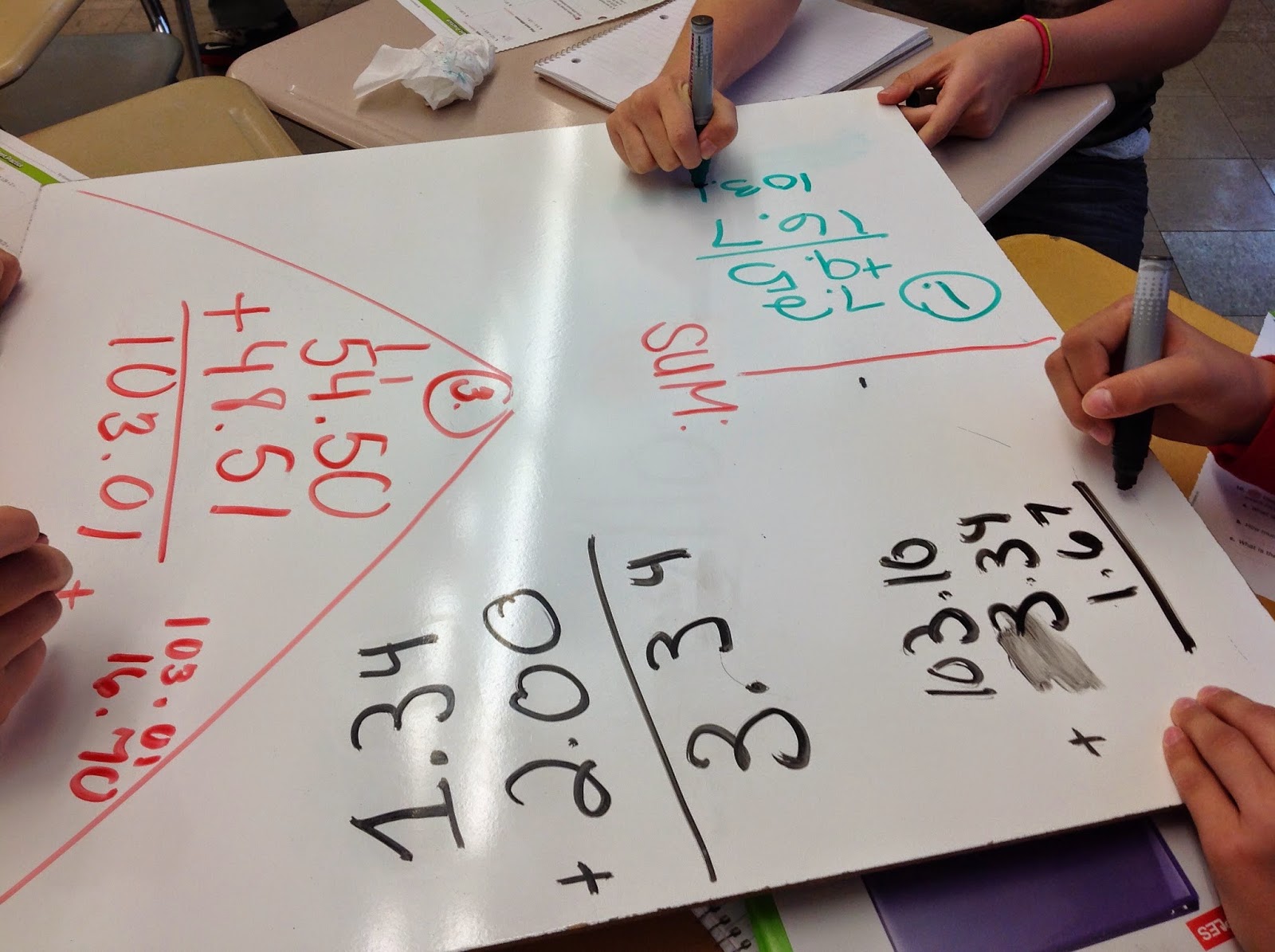
  6. We started the homework by having the students use the marker boards and find the sum of their different problems 
  7. The students worked on the rest of the homework independently, which came from the book for the first time this year 
Exit Ticket:


The Assessment: The marker boards are a great way to get students collaborating. It was also an excellent way for me to assess as three to four students had to all be correct at the same time since I was looking for the sum of all the answers in my assessment.


Homework: Page 181-182 of the math textbook, Weekly Quiz #3 was available online for students to work on.

My Glass Half-Full Take: After school I was feeling slightly overwhelmed. And it was Friday. I had to create a decimal quiz and study guide (I know there are some out there but there's always one little flaw that drives me nuts), I had to look over student journals and respond to them, grade the weekly quizzes, prepare the room for Monday, and had several other tasks that I could procrastinate on. Luckily for me I had four eighth grade students randomly show up and ask if I needed help. They did the random tasks that I was going to procrastinate on. They moved and added to my word wall, sharpened colored pencils, wrote the agenda and homework for Monday, made posters about how to solve word problems and some other random tasks. I mindlessly graded papers as they worked and an hour later my mood was altered.

One Thing to Do Differently: I created groups on the fly today. I need to make groups assigned and have students in heterogeneous grouping. I have done this in the past, but it's been harder this year because it's rare that for a whole day I will want to keep the desks in groups since I'm often teaching two different lessons to the same group (one lecture based and one hands on).

Link of the Day: A former colleague introduced me to Edudemic. A lot of top ten lists and tutorials around how best to use technology to your advantage.

Thursday, October 2, 2014

Day 22: Prime Factorization Quiz & Starting Decimals

6th Grade Math Standards: 6.NS.4 Find the greatest common factor of two whole numbers less than or equal to 100 and the least common multiple of two whole numbers less than or equal to 12. Use the distributive property to express a sum of two whole numbers 1-100 with a common factor as a multiple of a sum of two whole numbers with no common factor. For example express 36 + 8 as 4(9 + 2).
MA.4.a Apply number theory concepts, including prime factorization and relatively prime numbers, to the solutions of problems.
The Learning Objective: Find the prime factors of a number, find the greatest common factor of two numbers, differentiate between prime and composite numbers, define a prime number, define a composite number, identify place value from billions to ten thousandths

Quote of the Day: "As a leader, you must play the hand your dealt even when you don't like the cards - even when fate frowns upon you." - John Wooden

Agenda:

  1. Review the previous night's homework
  2. Take the quiz on the objectives 
  3. Students worked on their weekly quiz
  4. As students finished their weekly quiz I challenged them to think of 50 different ways that they could study
  5. At the start of class two, students wrote the homework in their agenda books
  6. The students took notes on place value. I just gave them a number that went from the ten thousandths to the billions place value and had them write it in their notebook horizontally so they fit one number in each line.
  7. We played Destination Elimination


The Assessment: The quiz was the assessment in the first half. Overall results were good. Students seemed to know what a prime and composite number were. The directions on the second half were a little confusing. Some students were finding the greatest common factor when the directions asked to find the prime factorization of two different numbers. Many students found a common factor of 72 and 96 without finding the greatest common factor.

In the second part of class, the assessment was seeing how students strategized and ordered decimals. This was a struggle. Not necessarily because students didn't know the decimals, but either my explanation was bad in some classes or the rules of the game was bad. By the last class I simplified it so that students only needed to put five numbers in order.

Homework: I had students answer this question based on this video.

My Glass Half-Full Take: A student came up to me during the quiz to ask me what he was doing wrong. Here's what he showed me:


He had factored 108 of all the prime numbers perfectly. The problem was when he went to check his work (as I had encouraged throughout the past couple of days), his answer of 98 did not match the number 108. I basically never help students during quizzes. I tell them do the best you can and reread directions that's it. This time though I couldn't help myself. I was happy that the student was checking the work and checking it the correct way. I simply asked him if he did the division part twice. His answer was yes. I then asked if he did the multiplication part twice. His answer was no. I smiled and said which one do you think needs another look then?

One Thing to Do Differently: I wanted to do a game in the second half of class or something that was more of a hands on activity after a quiz in the first part of class. That said, I should have done a mini lesson on comparing and ordering decimals for students. I also could have made a mini game of Destination Elimination. Next time (if there is a next time) I would only have them fill in three numbers instead of ten. I've read that Brazilian soccer players play games on fields one-sixth the size of a normal field to increase creativity in the game. I've also heard of basketball coaches creating one or two minute mini games to increase competition. I think shortening the length of this game would increase the intensity and engagement while not sacrificing any of the assessment.

Link of the Day: The frustration parents face with the common core. I have my own opinion, but don't have a year to write it. Maybe I will someday. For now let me just say two absolute certainties. The common core is here for now and the common core won't be here for good.

Wednesday, October 1, 2014

Day 21: Prime Factorization & Greatest Common Factor

6th Grade Math Standards: 6.NS.4 Find the greatest common factor of two whole numbers less than or equal to 100 and the least common multiple of two whole numbers less than or equal to 12. Use the distributive property to express a sum of two whole numbers 1-100 with a common factor as a multiple of a sum of two whole numbers with no common factor. For example express 36 + 8 as 4(9 + 2).
MA.4.a Apply number theory concepts, including prime factorization and relatively prime numbers, to the solutions of problems.
The Learning Objective: Use prime factorization to find a greatest common factor

Quote of the Day: “Many people believe that a person is born either smart, average, or dumb - and stays that way for life. But new research shows that the brain is more like a muscle - it changes and gets stronger when you use it.” - Carol Dweck

Agenda:


  1. Jumpstart with visual patterns number in which the students were asked to find the value of the 10th step (which they did quite well with)
  2. We reviewed the homework most notably the first five prime numbers and the prime factors of 1001
  3. We did notes on the objective
  4. We did pepper with the terms prime and composite as well as testing which numbers were prime and which were composite as part of giving them an idea of what was on the study guide
  5. Students were given the opportunity to start their homework in class
  6. If students finished they could work on the weekly quiz
  7. If students finished this, I let them use their cell phone to play 2048 or decorate our ceiling (only three students finished step six all day).

The Assessment: Starting the homework was the assessment today as many students were able to finish it.

Homework: This worksheet which was created by a colleague and I actually really liked better than anything a book or publishing company has offered over the last six years that I've seen.

My Glass Half-Full Take: Sometimes when you expect outright confusion, you don't get it. I'm not one hundred percent convinced my students will master prime factorization with greatest common factor on their quiz tomorrow particularly given that they do struggle with number sense. That being said, they did ok. My favorite part of today was that a student explained the visual pattern by stating that she knew there were 13 squares in step 3 and 7 steps between that step and step 10. Noticing that there was a difference in each step of 4 squares, she took the 7 steps that had a different of 4 each time and multiplied to get 28. She then added the 13 steps that were already in step 3 to get 41. I had never thought of the pattern in that way before.

One Thing to Do Differently: The idea of calling the method of prime factorization "birthday cake" or "factor trees" has caused students to lose site of what prime factorization is. I only had one student in a class tell me that writing a product of prime numbers is the same concept as prime factorization. For now, the students are not struggling with this material because it's what we are currently doing in class. When we mesh this topic with decimals, statistics, ratios, etc. it could be a whole different story. I've got to eliminate the use of the term "birthday cake" and call it prime factorization instead.

Link of the Day: Similar to get to 10, here is get to 24. This would probably an easier one to make into worksheets for someone like me who does not have technology as readily available as some school systems might (although the use of cell phones is a game-changer as I got to experience for the first time with one student).