Monday, December 26, 2016

Day 64: Part Given Whole

6th Grade Math Standards: 6.RP.3 Use ratio and rate reasoning to solve real-world and mathematical problems, e.g., by reasoning about tables of equivalent ratios, tape diagrams, double number line diagrams, or equations. a. Make tables of equivalent ratios relating quantities with whole-number measurements, find missing values in the tables, and plot the pairs of values on the coordinate plane. Use tables to compare ratios. b. Solve unit rate problems, including those involving unit pricing and constant speed. For example, if it took 7 hours to mow 4 lawns, then, at that rate, how many lawns could be mowed in 35 hours? At what rate were lawns being mowed? c. Find a percent of a quantity as a rate per 100 (e.g., 30% of a quantity means 30/100 times the quantity); solve problems involving finding the whole, given a part and the percent. d. Use ratio reasoning to convert measurement units; manipulate and transform units appropriately when multiplying or dividing quantities.

Objective: Find the part given the whole amount; find the whole given the part; find the percent given the part and the whole

Agenda:

  1. Open Middle
  2. QSSQ 
  3. Review of percent of a number homework 
  4. Proportion frayer model
  5. Part Given whole notes
  6. Part given whole practice 


Assessment: Students did some problems from the notes on their own as I circumvented and other students helped.

Glass Half-Full: The Open Middle problem was something students struggled with despite the fact that Robert Kaplinsky calls it a fourth grade problem. I decided not to go over the answer in any classes and hang onto the problem as a bonus for the quiz.

Regrets: I got lazy and did not interleave well at all on these notes. Students got used to setting up proportions, but never had to think about what number was a part and what number was a whole because the part was always the number that was given. If I could have even added one problem in which the whole was given (percent of a number) it would have forced students to think more about how the problem was written. These problems are an issue of literacy as much as math once the basic understanding of what a percent is met.

Saturday, December 24, 2016

Day 63: 20 Percent Off or 20 Dollars Off?

6th Grade Math Standards: 6.RP.3 Use ratio and rate reasoning to solve real-world and mathematical problems, e.g., by reasoning about tables of equivalent ratios, tape diagrams, double number line diagrams, or equations. a. Make tables of equivalent ratios relating quantities with whole-number measurements, find missing values in the tables, and plot the pairs of values on the coordinate plane. Use tables to compare ratios. b. Solve unit rate problems, including those involving unit pricing and constant speed. For example, if it took 7 hours to mow 4 lawns, then, at that rate, how many lawns could be mowed in 35 hours? At what rate were lawns being mowed? c. Find a percent of a quantity as a rate per 100 (e.g., 30% of a quantity means 30/100 times the quantity); solve problems involving finding the whole, given a part and the percent. d. Use ratio reasoning to convert measurement units; manipulate and transform units appropriately when multiplying or dividing quantities.

Objective: Determine if 20% off or $20 off is a better deal

Agenda:

  1. Self Assessment
  2. QSSQ
  3. Review the Quiz
  4. My Favorite No (20% of 64)
  5. 20% off or $20 off from Dan Meyer 
  6. Homework Practice

Assessment: I circumvented the room as students worked on the homework and the notes. There was also the self-assessment sheet that students got after the quiz. One of the sixty students could find the answer to the my favorite no question. That student used multiplication, so I worked with that student on the ten percent rule.

Glass Half-Full: This was probably the fourth time I've used Dan Meyer's Dualing Discount activity to teach how to find the percent of a number. It was probably the best that I have done because I let the students know ahead of time not to shout out ideas to enhance the likelihood that many students would be discovering that sometimes 20% was better and sometimes $20 off was better.

Regrets: This lesson does take more than one would think just looking at the agenda and especially the dueling discount problems. I did not use all of Meyer's problems, and did not need to either. My frustration was that we could not have a discussion or a a calculation surrounding at what point does the price of the item not matter regardless of the coupon. Perhaps I could speed this up by giving students four more examples (not have them do the calculation) and then give them more time to analyze what was happening.

Wednesday, December 7, 2016

Day 62: Fraction, Percentages, and Decimals Quiz

6th Grade Math Standards: 6.RP.3c. Find a percent of a quantity as a rate per 100 (e.g., 30% of a quantity means 30/100 times the quantity); solve problems involving finding the whole, given a part and the percent.

Objective: Convert between fractions, percentages, and decimals; compare and order fractions, decimals ,and percentages

Agenda:

  1. Quick study guide review (especially interleaving problem)
  2. QSSQ 
  3. Take the quiz
  4. Fix the weekly quiz 
  5. Find two factors that have a product of 1,000,000
  6. At the start of the next class pass out notes on comparing and ordering fractions, percentages, and decimals but I had students work in groups rather than do it as a lecture. The format worked well in the disciplined classes, but as much in the classes that were hyperactive. 
  7. Did page 135 #25-27 for homework. 

Assessment: Circumvented the room during number six. The quiz and weekly quiz were corrected by me.

Glass Half-Full: I'm happy that I only gave three homework problems. No need for more as I can tell who is doing well and who needs remediation from there.

Regrets: On the quiz most students struggled with making 3/8 a percentage. It could have been better highlighted as an area of concern coming into today. Not to say that the concept was not reviewed, but we should have been a star next to the concept of percentages with decimals.

Day 61: Final Quiz Prep

6th Grade Math Standards: 6.RP.3c c. Find a percent of a quantity as a rate per 100 (e.g., 30% of a quantity means 30/100 times the quantity); solve problems involving finding the whole, given a part and the percent.

Objective: Convert fractions, percentages, and decimals

Question of the Day: Is there any difference between 0.42 and .42?

Agenda:

  1. Visual Pattern #34
  2. QSSQ 
  3. Review HW (#13-15 and the back) & Pepper
  4. My Favorite No. Convert 0.3 into a percent. Convert 7% into a decimal.
  5. Practice of decimal and percentage conversion
  6. Study guide of converting between fractions, percentages, and fractions

Assessment: Circumventing the room during items three, five, and six of the agenda. During item two students simply brought their sticky notes up to me.

Glass Half-Full: The pace of this allowed for a good deal of feedback. I had students in work in partners on item number five in the agenda and I just circumvented the classroom. It was very apparent that the only difficulty involved one digit numbers or mixed numbers. Anything two digits the students had down. This was interesting because I resisted the temptation of telling students to slide the decimal two places. Instead I wildly praised students for writing each as a fraction out of 100 before converting.

I had students do the study guide as if it were the actual quiz. Inevitably I did give away answers and help them along, but it had a similar feel and the study guide was very much on par with the quiz.

Regrets: The homework from the night before should have had all the whole numbers changed from 2 to 1 in the four multiple choice options. I was the one that created that particular question, so score one for the math students.

Day 60: Percent Defined

6th Grade Math Standards: 6.RP.3c. Find a percent of a quantity as a rate per 100 (e.g., 30% of a quantity means 30/100 times the quantity); solve problems involving finding the whole, given a part and the percent.

Objective: Convert fractions to percentages; convert percentages and decimals

Agenda:

  1. Open Middle (third grade problem) 
  2. QSSQ 
  3. Pepper
  4. Practice with fraction and decimal conversion
  5. Percentage definition 
  6. Converting between fractions, decimals and percentages notes
  7. Fractions, decimals and percentages practice

Assessment: I circumvented the room as students worked out solutions to the problems. I really tried to sell students to write out the fraction before finding the decimal equivalent of a fraction. Single digit numbers are frequently a misunderstood concept because of a lack of place value knowledge and the ignorance of what the term percentage really means.


Glass Half-Full: Despite the third grade label of the warm up problem, the students were challenged and required to persevere. It was a problem that brought out students that do not normally shine and brought down those that normally do.

Regrets: I did not really do a good job of connecting the importance of this lesson to the real world. In past years, I take a box score from a sporting game, but I forgot today and also part of me said that the kids that hate sports probably hate me.

Day 59: Decimal & Fraction Conversion

6th Grade Math Standards: 6.RP.3c c. Find a percent of a quantity as a rate per 100 (e.g., 30% of a quantity means 30/100 times the quantity); solve problems involving finding the whole, given a part and the percent.

Objective: Convert from fractions to decimals

Agenda:

  1. Self-Assessment
  2. QSSQ 
  3. Review Test
  4. My Favorite No. Convert 5/6 to a decimal. Find your grade.
  5. Notes on conversion from decimal to fraction and then fraction to decimal
  6. Exit Tickets. 


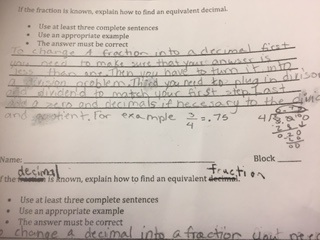
Assessment: The my favorite no was telling. In one class nobody could convert five-sixths to a decimal. One student said 0.83, but without the repitin bar. All year myself and the social studies teacher have been putting the grades in fraction form. It turns out the students would have practically no clue to know what they actually got for a grade (see picture). They did much better with the grade after the feedback of five-sixths was given.


There was also the exit ticket.

Glass Half-Full: We had a curriculum day earlier in the week. The focus for the whole year has been on writing. The cry from the math department is that we did not need writing as much. Now I'm typically of an open mind, so I went into today's meeting willing to learn, think, and be persuaded.

Ultimately the conclusion I reached was (as the common core sort of states) that I am a writing teacher. With that thought in mind, I really tried to focus on the exit ticket from a writing perspective. I wanted students to nail the math by telling a fifth grade student how to convert (see objective), but also to use solid transition words in describing the process. What I got was a mixed bag. That was not the important part. The important part was incorporating professional development into my lesson immediately after receiving professional development.


Regrets: The writing prompt should state that the directions on conversions are for a fifth grader and that I'm focused on the transition words, but I explained this orally. Like I said, focusing beyond the math in their writing is a new thing for me.

Day 58: Fraction Test

6th Grade Math Standards: Interpret and compute quotients of fractions, and solve word problems involving division of fractions by fractions, e.g., by using visual fraction models and equations to represent the problem. For example, create a story context for (2/3) ÷ (3/4) and use a visual fraction model to show the quotient; use the relationship between multiplication and division to explain that (2/3) ÷ (3/4) = 8/9 because 3/4 of 8/9 is 2/3. (In general, (a/b) ÷ (c/d) = ad/bc .) How much chocolate will each person get if 3 people share 1/2 lb of chocolate equally? How many 3/4-cup servings are in 2/3 of a cup of yogurt? How wide is a rectangular strip of land with length 3/4 mi and area 1/2 square mi?

Objective: Divide fractions to find a quotient; locate a fraction between two numerators of a like denominator that are next to each other on the number line (find what's between 10/3 and 11/3); multiply fractions to find a product; add fractions to find a sum; subtract fractions to find a difference

Agenda:

  1. QSSQ
  2. Fractions Test
  3. Work on WQ 
  4. Challenge Problems
Assessment: The test.

Glass Half-Full: The operations were done on problems one through eight and if that was the entire test grades would have been much higher. Kids can carry out the algorithm. Not surprisingly it's the higher order stuff such as application in the real world and finding holes between 10/3 and 11/3 where we struggled.

Regrets: The assessment included an interleaving question of 46 divided by 5. Students were instructed to find it using decimals, but I never reviewed this as part of the study guide the day prior, so I was not as stringent as the other math teachers probably were when students gave an answer of 9 and 1/5.

I also feel like this test is not as high up Bloom's Taxonomy as it could be.