Wednesday, November 30, 2016

Day 57: Who Wants to Be a Millionaire?

6th Grade Math Standards: 6.NS.1 Interpret and compute quotients of fractions, and solve word problems involving division of fractions by fractions, e.g., by using visual fraction models and equations to represent the problem. For example, create a story context for (2/3) ÷ (3/4) and use a visual fraction model to show the quotient; use the relationship between multiplication and division to explain that (2/3) ÷ (3/4) = 8/9 because 3/4 of 8/9 is 2/3. (In general, (a/b) ÷ (c/d) = ad/bc .) How much chocolate will each person get if 3 people share 1/2 lb of chocolate equally? How many 3/4-cup servings are in 2/3 of a cup of yogurt? How wide is a rectangular strip of land with length 3/4 mi and area 1/2 square mi?

Objective: Divide fractions in order to find a quotient; Place a fraction with a different denominators between two like fractions with numerators that are one apart on a number line (what fraction is between 11/3 and 12/3?)

Question of the Day: "Why is it that 3 and 4 will bring the same product and least common multiple, but 9 and 6 do not have the same product and least common multiple?"

Agenda:

  1. Determine what fraction is between 11/3 and 12/3
  2. Visual Pattern #32
  3. QSSQ 
  4. Review Homework and Pepper
  5. Who Wants to Be a Millionaire (second class). All 13 questions are going to appear on the test (students do not know this) 

Assessment: The students used individual marker boards during Who Wants to Be a Millionaire; I circumvented the room for homework and pepper


Glass Half-Full: The way the timing worked out in this lesson could not have been much better. The routine of steps one through four combined with the novelty of step five in the second class was the right balance for engagement and learning to happen across many types of learners. Everything done was assessable and gave students an indication of where they were proficient and where they were lacking skills (needed reteaching or simply to cross their T's).

Regrets: I could not do all 13 questions on Who Wants to Be a Millionaire as a result of reteaching as I found student misconceptions. Ultimately, I think I would have been better off if I had strategically placed a question with each operation as well as the objective of locating fractions between number lines back to back. What ended up happening was that one class never needed to find a fraction between two like fractions and another did nothing but find a fraction between two like fractions as a result of me trying to compensate for my mistake in the first lesson. Just need to find a balance between the two and could do so by skipping around on Who Wants to Be a Millionaire rather than doing each question one by one. Students these days do not really remember how Who Wants to Be a Millionaire is supposed to be played anyway.

Day 56: Fraction Stations

6th Grade Math Standards: 6.NS.1 Interpret and compute quotients of fractions, and solve word problems involving division of fractions by fractions, e.g., by using visual fraction models and equations to represent the problem. For example, create a story context for (2/3) ÷ (3/4) and use a visual fraction model to show the quotient; use the relationship between multiplication and division to explain that (2/3) ÷ (3/4) = 8/9 because 3/4 of 8/9 is 2/3. (In general, (a/b) ÷ (c/d) = ad/bc .) How much chocolate will each person get if 3 people share 1/2 lb of chocolate equally? How many 3/4-cup servings are in 2/3 of a cup of yogurt? How wide is a rectangular strip of land with length 3/4 mi and area 1/2 square mi?

Objective: Interpret the relationship between fractions with unlike denominators on a number line.

Question: How is a fraction like 10 and 25/24 going to be fixed?

Agenda:

  1. Estimation 180 (Lights)
  2. QSSQ
  3. Stations (word problem strategies, number line, stop and think, peanut butter blossoms, WQ) 
  4. Exit Ticket (using clickers)
  5. Start the homework 

Assessment: I stayed at one group of desks and focused on the number line concept that was listed in the objective.


Glass Half-Full: The clickers exit ticket was new to this year and really helped alleviate some of my concern regarding an issue that is a chronic red x when students take the test. They are overwhelmed by the number of steps involved in these problems so I tried to keep it really simple by saying get everyone to speak the same language. In other words make them all improper or mixed and then make them all have the same denominator and then reevaluate the question.

Regrets: Not even checking in on the groups in the other stations was a huge issue because it meant that they were unaccountable. For students that lack self-discipline this meant that they essentially got nothing done. Coming off of Thanksgiving break and getting back into fractions after a five day layoff, that meant that they might be lacking the skills they need to have.

Day 55: The Brain Bowl

For the second straight year before Thanksgiving we brought the entire sixth grade together to do a "so far year in review" trivia challenge. Every student is given a TurningPoint Clicker and then given multiple choice questions from all four core subjects (science, social studies, ELA, and math) as well as pop culture and random trivia questions (who played college sports for example). The clickers keep track of score automatically for us, so the students enjoy the competitive aspect of playing for their homeroom and for their core team (either Alcott or Hawthorne in our school). After about 30 minutes, two students are then chosen from each of the ten homerooms to compete in a final round. Where we continue to give multiple choice questions and give those twenty students exposure and make all of the things that they have learned and worked hard to practice worth knowing - even if they asked, "When are we going to use this in the real world?" 

I like this activity on this day for two reasons. First of all, units are being wrapped up or should be put on hold if they are not being wrapped up at this time of the year. To give an assessment on this day is hard because the classes are shortened with a half-day. If classes were to be held as if it were business as usual, the students would be unlikely to bring the same level of focus we typically see and some students are also already gone to visit grandma in Connecticut. Second, it gives the students a sense of school pride and a positive affiliation with school. This is a marathon and the enjoyment of this experience is building the appreciation of each curriculum for the students. Did we get closer to conquering the common core, getting a perfect score on PARCC, enrolling in Harvard, curing cancer, and teaching the future first president to achieve world peace and plant wheat crops on Mars? Not quite. What we did do was give students a fun memory from the year and also got a decent formative assessment for our troubles. 


Friday, November 25, 2016

Day 54: Dividing by Multiplying by the Reciprocal

6th Grade Math Standards: 6.NS.1 Interpret and compute quotients of fractions, and solve word problems involving division of fractions by fractions, e.g., by using visual fraction models and equations to represent the problem. For example, create a story context for (2/3) ÷ (3/4) and use a visual fraction model to show the quotient; use the relationship between multiplication and division to explain that (2/3) ÷ (3/4) = 8/9 because 3/4 of 8/9 is 2/3. (In general, (a/b) ÷ (c/d) = ad/bc .) How much chocolate will each person get if 3 people share 1/2 lb of chocolate equally? How many 3/4-cup servings are in 2/3 of a cup of yogurt? How wide is a rectangular strip of land with length 3/4 mi and area 1/2 square mi?

Objective: Divide fractions by multiplying by the reciprocal of the divisor

Agenda:

  1. Open Middle find a quotient of 1/20 
  2. QSSQ
  3. Review the homework
  4. Reciprocals
  5. Show students the difference between 6 divided by 2 and half of 6
  6. Dividing by Multiplying by the reciprocal practice 

Assessment: I had students stand up when they tried multiplying by the reciprocal problems on their own; checking the homework

Glass Half-Full: The open middle problem was solved by the students, but not me. I gave up after five minutes and checked the solution to see if it was as hard as I was making it. I couldn't do it without using a whole number or improper fraction cause my brain was on Thanksgiving. When I saw the answers, I saw that I might not be qualified to teach mathematics since I gave up and since it was very very easy. When the students were able to do the problem with pretty high efficiency, it was confirmed that I should be thankful that I have a job because at times they could definitely take the mic from me.

Regrets: When students stood up, they had the correct answer, but were still finding a common denominator. Is there anything wrong with that? To me, this is one of those situations where maybe adding a tool to the toolbox is not a big deal.

Link: The most fun cities. Just for the record I've been to 7 of the best 10 and 4 of the best 5.

Day 53: Dividing Fractions with a Common Denominator

6th Grade Math Standards: 6.NS.1 Interpret and compute quotients of fractions, and solve word problems involving division of fractions by fractions, e.g., by using visual fraction models and equations to represent the problem. For example, create a story context for (2/3) ÷ (3/4) and use a visual fraction model to show the quotient; use the relationship between multiplication and division to explain that (2/3) ÷ (3/4) = 8/9 because 3/4 of 8/9 is 2/3. (In general, (a/b) ÷ (c/d) = ad/bc .) How much chocolate will each person get if 3 people share 1/2 lb of chocolate equally? How many 3/4-cup servings are in 2/3 of a cup of yogurt? How wide is a rectangular strip of land with length 3/4 mi and area 1/2 square mi?

Objective: Divide fractions using a common denominator

Agenda:

  1. Visual Pattern #27
  2. QSSQ 
  3. Division of Fractions Intro. You and three friends get a pizza (I display a pizza on the board). Then I tell kids to look at the back wall to see what's different. When they turn around, I've changed the board to show that one slice is missing and your brother took it. They fell for the oldest trick in the book. Now how are we going to split the pizza with 7 slices (7/8 of a pie) among 4 people?
  4. Think, pair, share
  5. Review how to divide fractions by finding a common denominator
  6. Notes including a number line 
  7. Independent practice and homework

Assessment:

Glass Half-Full: I found this helpful link about dividing fractions from Republic of Math about 20 minutes before school and wanted to incorporate it somehow into the lesson. I thought it was a useful of thinking about the problems and technically the standard does use the term visual fraction model. I doubt most students found it helpful, but there were probably a few, and I'm teaching "what I'm supposed to."

I have never taught students by making them find a common denominator first. The thought occurred to me in the moment when students were solving the activator problem with the pizza that most of them were in essence trying to either split the pizza into thirty-seconds or making sure each person got 1.75 slices. I don't think that students were making any connection to multiplying by a reciprocal. That was only brought about as a result of memorization. As the above link does delve into the students could eventually learn about multiplication of the reciprocal through self-discovery, but it's usually not the first maneuver students go to. Plus when we start talking about integrating the other operations, it's less for students to be confused by.
Just find a stupid common denominator. Even if you multiply. I don't care. Do it.

Regrets: I was vague as to whether students needed to find the number of slices per person or the fraction of the whole pizza per person. The two questions are different, so it would be best to ask both on the same slide. More students determined 1.75 slices per person than 7/32 of a pizza per person.

Link: Good way to practice coordinate plane and celebrate Black Friday from Robert Kaplinsky.

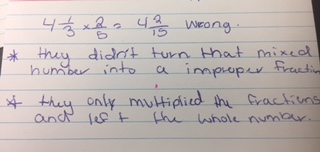
Day 52: Why 4 and 1/3 Times 2/5 Isn't 4 and 2/15

6th Grade Math Standards: 6.NS.1 Interpret and compute quotients of fractions, and solve word problems involving division of fractions by fractions, e.g., by using visual fraction models and equations to represent the problem. For example, create a story context for (2/3) ÷ (3/4) and use a visual fraction model to show the quotient; use the relationship between multiplication and division to explain that (2/3) ÷ (3/4) = 8/9 because 3/4 of 8/9 is 2/3. (In general, (a/b) ÷ (c/d) = ad/bc .) How much chocolate will each person get if 3 people share 1/2 lb of chocolate equally? How many 3/4-cup servings are in 2/3 of a cup of yogurt? How wide is a rectangular strip of land with length 3/4 mi and area 1/2 square mi?

Objective: Analyze the products of fraction problems in a mathematical context; find products in a real world context through multiplying fractions or using equivalent ratios

Agenda:
  1. Which one doesn't belong?
  2. QSSQ 
  3. Review the homework
  4. Exit Ticket on why 4 and 1/3 times 2/5 does not equal 4 and 2/15
  5. Mashed Potato Recipes from Yummy Math
Assessment: The homework was assessed to see students comfort level in cross reducing. Some students were on the fence as to how cross reducing would make life simpler and not more complicated. There was the exit ticket (the subject of the amount of liquid in the glass) and the mashed potato recipes were collected by me to see where students were on old concepts integrated with new concepts.

Glass Half-Full: About 83% of the students had something logical to say about the exit ticket. I think it helped that it was connected to the question of the day as well.


Regrets: The mashed potato exercise was good, but there was no time to review the results. I even gave them the answer to problem one. Somehow we have to do a better job of time management because it would have been good to review for the whole crew after collecting the work and seeing the various misconceptions and multiple points of entry for those that did solve.


 Here the student triples the ingredients when the number of people to serve was not tripled.

Here the student correctly changes the ingredient, but the denominators in each picture are different.


Link: Many of the ideas in this blog post about 16 Ideas for Student Projects Using Google Docs, Slides, and Forms I was familiar with, but I thought a cool add on for my curriculum was to have students create their own form and have classmates answer it when we do statistical questions.

Thursday, November 17, 2016

Day 51: Multiplying Fractions

6th Grade Math Standards: 6.NS.1 Interpret and compute quotients of fractions, and solve word problems involving division of fractions by fractions, e.g., by using visual fraction models and equations to represent the problem. For example, create a story context for (2/3) ÷ (3/4) and use a visual fraction model to show the quotient; use the relationship between multiplication and division to explain that (2/3) ÷ (3/4) = 8/9 because 3/4 of 8/9 is 2/3. (In general, (a/b) ÷ (c/d) = ad/bc .) How much chocolate will each person get if 3 people share 1/2 lb of chocolate equally? How many 3/4-cup servings are in 2/3 of a cup of yogurt? How wide is a rectangular strip of land with length 3/4 mi and area 1/2 square mi?

6.G.2 Find the volume of a right rectangular prism with fractional edge lengths by packing it with unit cubes of the appropriate unit fraction edge lengths, and show that the volume is the same as would be found by multiplying the edge lengths of the prism. Apply the formulas V = lwh and V = bh to find volumes of right rectangular prisms with fractional edge lengths in the context of solving real-world and mathematical problems.

Question of the Day: Tom Brday throws 8 touchdowns for every three interceptions. What is the ratio of interceptions to touchdowns?
Objective: Multiply fractions by fractions to find a product; multiply fractions by whole numbers to find a product; multiply mixed fractions to find a product

Agenda:

  1. Self-Assessment from the addition and subtraction quiz
  2. QSSQ
  3. Review the Quiz
  4. My Favorite No 
  5. Pepper
  6. Notes
  7. Clickers (exit ticket)
  8. Homework started in class


Assessment: I had the students multiple 1/3 by 2/5 to see what they already knew about multiplication of fractions. In one of my classes 11 of 18 students answered 2.


During the notes, students were consistently asked to try on their own before I showed them what to do and I circumvented the room at this time. There was a popular answer of 4 and 1/3 times 2/5 being 4 and 2/15. That was such an issue that it is going to become the question of the day for tomorrow. 

The clickers were only used for one class. I had a two step problem that required students to add and subtract fractions as well as multiply them. 

Glass Half-Full: As the 6th grade standards above indicate, there is nothing that is directly saying that students need to multiply fractions. It is a fifth grade standard. They do have to build upon their knowledge of multiplying though in order to find volumes and make sense of dividing fractions. So the novice in me would say let's just go right to division. The novice in me died a few years ago. When 11/18 of students answer a question wrong, there is a fraction problem (pun intended). Today's lesson was necessary, and hopefully impacted the students recognition of how to carry out the algorithm.

Regrets: The notes are designed to show students why a fraction times a fraction cannot equal two or anything greater than one. It was put in there, but once the robots - I mean students - start to multiply the numerator by the numerator and the denominator by the denominator, they lose site of this concept.

Link: Lost at School was a valuable read for me (although it took me two months to finish because I'm a horrible reader at busy times) in terms of classroom discipline. I think it confirmed many things for me and also showed me that repeated disciplinary actions are cause to change the way you see a problem in the classroom.